Why You Can Understand English But Can’t Speak or Write It: The "Penny Paradox"
*This is Part 1 of a three-part series on understanding English input (reading and listening) and output (speaking and writing). Today's post: Language input is passive recognition.*
Have you ever listened to a podcast and understood every word, but then struggled to explain what it was about five minutes later? As a language learner, this is frustrating. But from a brain science perspective, this is perfectly normal. Your brain is designed to take shortcuts. In the world of linguistics, we call this Passive Recognition.
🪙 The Penny Test: Recognition vs. Reproduction
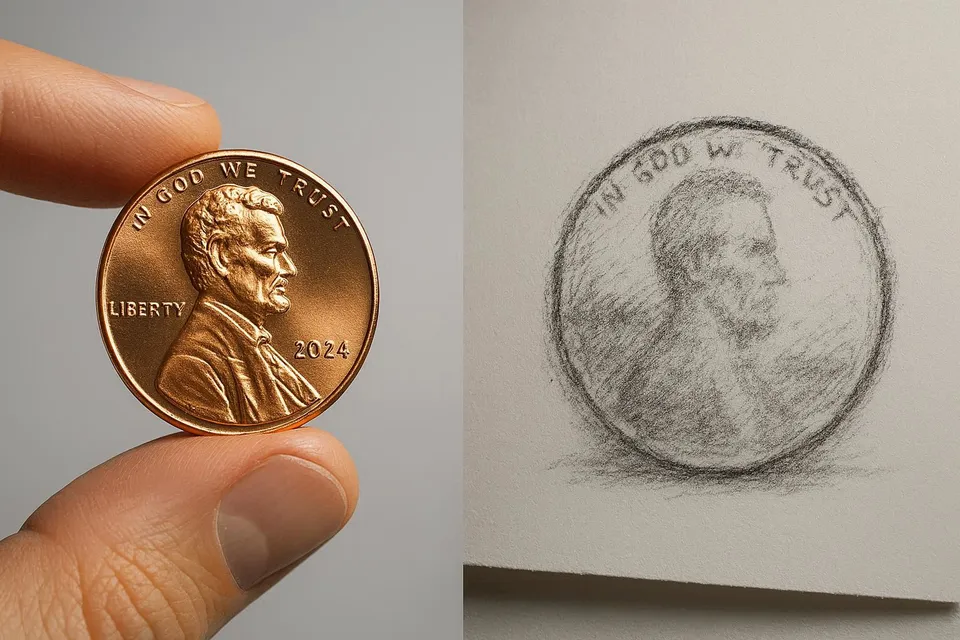
Imagine I hold a penny between my fingers. Even a five-year-old can instantly tell you, "That’s a penny."
Now, I give that same person a piece of paper and say, "Draw the penny. Include every detail."
Even an expert at the U.S. Mint would likely fail. Why? Because to recognize a penny, your brain only needs two or three "fuzzy" markers: the color copper, the size, and a blurry profile of a face. Your brain ignores the rest to save energy.
The Lesson: Passive recognition is "fuzzy." It doesn't require accuracy; it only requires "good enough."
🧠 How Your Brain "Cheats" at Reading and Listening
In neuroscience, we describe the brain as a prediction engine. When you read or listen to English, you aren't actually processing every single letter or sound. You are "cheating" using two specific methods:
1. Contextual Filling (The Cloze Effect)
Your brain uses the words it does know to guess the words it doesn't.
- Example: "The cat sat on the ______."
- Your brain fills in "mat" or "floor" before you even see the word.
This is why Cloze Tests (fill-in-the-blank) are so common in language exams. They test your ability to use context. However, this "cheating" has a danger zone. If you miss a "core word"—like a "not," "happily," or "barely"—you might understand the opposite of what was actually said.
2. Key-Word Sampling
In listening comprehension, your brain acts like a filter. It hunts for stressed nouns and verbs.
- What you hear: "...yesterday... mall... bought... shoes..."
- What your brain concludes: "He went shopping yesterday."
You didn't process the prepositions, the articles, or the tense endings. You got the "intent," but you didn't master the "mechanics."
⚡ The Neural Gap: Input vs. Output
Why is this a problem? Because Speaking and Writing (Active Recall) require a completely different neural pathway than Reading and Listening (Passive Recognition).
- Passive Input: Your brain is a consumer. It identifies patterns that already exist.
- Active Output: Your brain is a creator. It must build the pattern from scratch.
If you only practice passive input, you become a master at "recognizing the penny," but you will never develop the "muscle memory" to draw it.
This is the first post in a three-post series. In our next post, I'll shift to Speaking and Writing, i.e. language output. Stay tuned for Part 2!